TEXTILES.ORG


Lighting looks for less
Economic lighting design delivers stylish simplicity without breaking the bank.
By Holly O’Dell
To accommodate ever-growing interest in creating a memorable event, many tent rental companies will add to or upgrade their accessories. Lighting often tops the list of this evolving stock, and for good reason: not only does it offer the basic function of illumination, but with so many options available it can create that extraordinary atmosphere craved by customers.
This broad assortment of lighting styles can include string, bistro, par cans, wireless LEDs, gobos/projections, paper lanterns and a variety of chandeliers. Developing the right type and amount of inventory, however, presents some challenges. “Lighting and interior design is more expensive than the actual tent itself,” says Alexander Lorman, president of Nassau Tent Party Services and Event Rentals in West Babylon, N.Y.
It’s not always a matter of simply acquiring the cheapest option and passing savings on to the client. “Not only do you have [to consider] the cost of the light fixtures you need to invest in and pay off, but also the time and labor involved in installing them, as well as running the power lines,” says Bryan Loane, owner and president of Loane Brothers Inc. in Towson, Md.
Although lighting can represent a significant expenditure, tent and event rental companies are making the effort to accommodate cost-conscious customers without sacrificing performance or style.
Multicolored LED ground lighting integrated with the site’s existing landscape uplights frames the event. Photo: MAK Photography
String theory
One of the most common ways to develop an inexpensive lighting scheme is through string lighting. For a wedding at Epping Forest Yacht and Country Club in Jacksonville, Fla., Beachview Event Rentals and Design of Woodbine, Ga., installed string lighting to create a starry night effect in the ceiling of the tent. “It is one of our most economical choices as it is charged by the square foot, not by the fixture,” says Anna Helms, a designer with Beachview. “You can easily create more or less lighting by the space of the strands.”
Nolan’s Rental Inc. in Webster, N.Y., often pairs its apollo chandeliers with mini string lights used around the perimeter of the tent. These chandeliers—white vinyl fixtures comprised of four white globes—are the least expensive chandeliers offered by Nolan’s, but they maintain great quality, according to sales representative Greg Witkowski.
Meanwhile, the rental company’s 40-foot and 60-foot strings feature LED bulbs that use small amounts of power. They also serve as a less expensive alternative to the bistro lights offered by Nolan’s, which Witkowski says have become very popular in the past year.
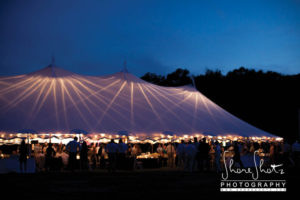
Chase Canopy offers onion lamps custom made with a ribbed glass. “These have become very popular with the increase of use of the Tidewater Sailcloth tents by Aztec Tents,” says Ben Philbrook, of Chase Canopy. Photo: Shore Shotz Photography
“They are more expensive than the 40-foot and 60-foot strings of LED lights, but if you budget this correctly they can be affordable,” Witkowski says. The reason for the higher price? “They are a really high-quality light and have a glass bulb so they are specially wrapped and protected. We are the only ones that do the install of the bistro lights as well, so there is a charge for the labor of doing that.”
With its ability to accentuate floral pieces on a tabletop while illuminating the rest of the tent, pin lighting offers another option in the economical lighting arsenal. There are two keys to making pin lighting effective, according to Loane. “Although concentrated to a small area, pin spots give off ambient light, and lighting is cumulative, so you really need less additional lighting for the entire space,” he says. “Otherwise it can just make the room too bright.”
It’s also critical to double check lighting placement. “A lot of times pin lighting is installed in the afternoon,” Loane says. “Then the caterer switches some things around and a table shifts a couple of feet but the light doesn’t. So, you have to be able to re-aim things up until the last minute.”
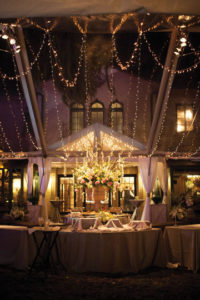
Beachview Event Rentals & Design says string lighting is one of the company’s most economical lighting options because it is charged by the square foot, not the fixture. Photo: MAK Photography
Low power, high style
Low-energy LED lighting, particularly in its wireless form, continues to rise in popularity while making headway in affordability. “The wireless LED can lights can be a cheaper alternative to traditional mounted light,” Beachview’s Helms says. “The wireless feature is great, taking away the limited mobility of typical plug-in can lights. It also allows the client to accent certain areas with their color of choice without breaking the bank.”
Loane says that individual wireless LED can lights, which average $600 apiece, have a high upfront cost to tent companies but pay off in other ways. “You do not need to run a power line to them, which not only saves on labor but is a lot cleaner looking,” he says. “Lighting can require the use of a generator, potentially adding hundreds or thousands of dollars to a bill. Battery-operated LED lights avoid that.”
Wireless LED lighting is often used in conjunction with another ongoing trend: light-up furniture. The most popular choice among customers of Nolan’s Rental is the light-up bistro table with white spandex cover.
“These are really cool because you can make the bistro any color or they can change through colors during your event,” Witkowski says.
Nassau Tent’s Lorman also touts the stunning combination of liners and LEDs. “Fabric swags with correct placement of LED lights create beautiful 3-D visuals.”
Above all, Les Sumpter, owner of A Rental Connection in Canoga Park, Calif., recommends keeping in mind the role simplicity plays in an economical lighting design. “The fewer moving parts, the better,” he says. “When you start getting into a lot of action lights where everything is computer-generated and attached to dimmer boards, you need several technicians to be on-site to program everything. The labor and the fixtures can get really expensive. These lights demand a lot of energy, and that will also increase the bill.”
Instead, Sumpter lets budget-conscious customers know that “to have a lighted bar, lighted furniture cubes and a wall washed in light changes the whole mood of an event.”
Holly O’Dell is a freelance writer based in Joshua Tree, Calif.
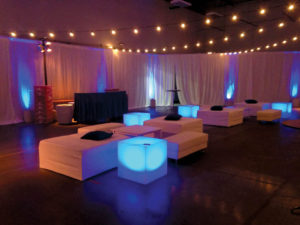
Furniture cubes lit with energy-efficient LEDs introduce a soft, diffused glow in a variety of colors, while serving as seating or end tables in a lounge-like setting. Photo: A Rental Connection
Is it better to outsource lighting?
After reviewing its inventory, sales and installation approach to lighting at the start of 2015, Chase Canopy Co. in Mattapoisett, Mass., came to one conclusion. “We realized we are a rental company, not a lighting company,” says Ben Philbrook, Chase Canopy’s director of operations.
Chase discovered that as the company grew, it was selling more lighting jobs (and buying more lights) and, more often than not, spending more time on lighting than on the actual tent installation.
“We found that our more experienced tent installers were the ones being held up on jobs to install lighting,” Philbrook says. “We also found this to be crippling as their expertise installing tents was not being put to use as they were worrying about wattage and running extension cords.”
To that end, Chase has gone back to the basics, offering basic string and cafe lighting, along with onion lamps custom made with a ribbed glass. Work lighting and spotlights also are available.
Philbrook’s advice for other tent and event rental companies? “Call a lighting company. They are true professionals that do this day in and day out. They understand the electrical needs for all their equipment and know best how to utilize lighting to create an event atmosphere.”